Reservations for
Florida State
Parks are now
made through
Reserve America,
toll free, at
1-800-326-3521
|
PAYNES
CREEK STATE HISTORIC SITE
In the decade
following the second Seminole Indian War, friction continued between the
Seminoles and the white settlers who were continually encroaching on the
land. The Seminoles often traveled from the interior of Florida to the
Gulf coast to trade, passing white settlements -- a potential source of
conflict. The U.S. authorities attempted to eliminate this volatile situation
by establishing a trading post for the Seminoles in the interior. They
calculated the post would eliminate the necessity to pass near white settlements
and would establish, for the first time, a contact point where the Seminoles
could easily be reached whenever the need arose to communicate with them.
Therefore, the Darling Store was established in the spring of 1849. The
spot selected was Paynes Creek (un-named at that time) on the northern
boundary of the Reservation. It was attacked by five Seminoles on July
17, 1849. They opened fire on three clerks; Captain George S. Payne, Dempsey
Whiddon and William McCullough. Whiddon and Payne were killed. Their grave
site is now marked with a stone monument near the location of the old
store. McCullough escaped with this wife and child, although he was wounded
in the shoulder and leg.
The attack resulted from the
action of five individuals, one of whom had been previously outlawed by
his tribe. The Seminoles wished to avoid a conflict. They captured three
of the culprits and killed a fourth. The fifth man escaped. The prisoners
were turned over to the government in an attempt at appeasement. However,
it took the government a while to realize the misunderstanding. In the
meantime, federal troops were sent to Florida and plans were made for
a campaign against the Seminoles. The strategic plan for removing them
called for establishing a chain of forts, 10 miles apart, from the Manatee
River to the Indian River. This line of outposts across the northern boundary
of the Reservation would be to protect the settlers to the north and to
establish bases from which the Seminoles could be pursued and harassed
until they surrendered.
Work began on the first fort
on October 26, 1849, on an elevated spot of ground, one-half mile north
of the trading post. The fort took its name from the name of the store
which had come to be known as "Chokonikla," a variant spelling
of the Native American word for "burned house."
No fighting occurred at the fort,
although a number of men died from disease. Sickness, particularly malaria
and fever, were constant problems and ultimately caused the fort to be abandoned
(July, 1850). As many as 223 men, including a regimental band, were garrisoned
at the fort at one time, but usually the number was smaller. The events
of 1849 did not immediately lead to war. The conflict was postponed until
1855 when a band of Seminoles attacked a military surveying party near Fort
Myers. Although some of the Seminoles surrendered and were sent to Oklahoma,
others remained hidden in the swamps of southern Florida where their descendants
remain to this day. The remaining Seminoles never surrendered. They later
signed a peace treaty with the U.S. Government in 1936 during the administration
of Franklin D. Roosevelt.
ACTIVITIES
Trails lead through the woods to the high ground where
Fort Chokonikla once stood and to the location of the Kennedy Darling store.
Near this feature is the stone monument marking the burial place of George
Payne and Dempsey Whiddon.
Exhibits interpreting
the Seminoles, Fort Chokonikla, the trading post and events that occurred
here are located in the visitor center.
Picnic tables
and shelters are available for visitors to relax and enjoy lunch and the
surroundings.
Fishing opportunities
are available in the Peach River. A Florida freshwater fishing license
is required for persons 16 years of age or older.
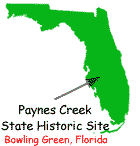
Paynes Creek State Historic Site is located one half mile east of Bowling Green.
For more information on this
park, write to:
Paynes Creek State Historic Site
888 Lake Branch Road
Bowling Green, Florida 33834 or call (941) 375-4717
e-mail - pcshs@strato.net
View Larger Map
|
|